How the Google ecosystem, Meridian-grade measurement, and agentic AI fit together as one system — and the audit, readiness, and decision-economics tools to operationalize it. Three connected tools designed to be used inside a real organization, by a real team, in a real budget cycle.
This is the thought-leadership side of Uncommon Move — the structural argument. The working tools (the Lab, the Cost Per Decision calculator) live on the practitioner side.
Get the framework →The conversations about Google Ads, marketing measurement, and agentic AI have been happening in three separate rooms. The teams that win the next decade put them in the same room. Each tool is the connective tissue between conversations that usually don't touch.
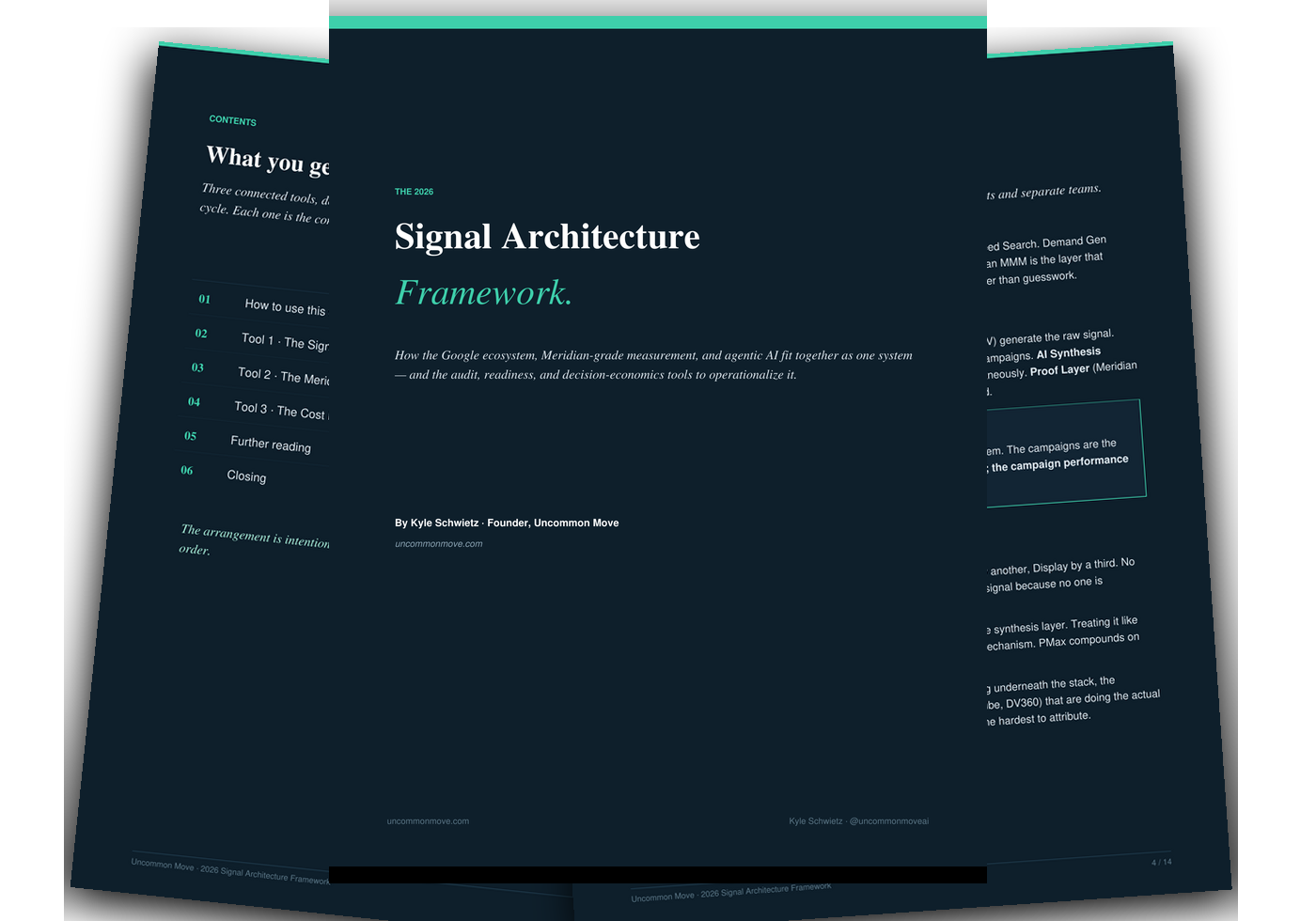
A four-tier diagram of how signals actually move through the Google ecosystem — Signal Sources, Activation, AI Synthesis, and the Proof Layer. Use it to brief executive leadership on why the channels are not the strategy — the flow between them is. Includes three diagnostic questions to find out where your organization actually sits on the flow.
Twelve checks — six technical, six organizational — that determine whether a Marketing Mix Modeling engagement will produce findings the organization will actually act on. Most teams pass the technical checks and fail the organizational ones. Run this before commissioning the model, not after.
The CFO-readable version of the agentic AI conversation. A four-input model that translates marketing decision velocity into financial-engineering language — Cost Per Decision, equivalent FTE capacity, and share of marketing payroll. Includes the formulas, a worked example for a 40-person org, and the framing to use with finance.
A curated reading list mapping each tool to the long-form essays behind it — including the GA4 audit teardown, the Meridian deep dive, and the agentic AI argument. Plus the companion Cost Per Decision and Decision Latency calculators, the full Uncommon Move frameworks collection, and Kyle's Daily Morning Drive briefing.
You own — or influence — a meaningful enterprise marketing budget and you're tired of the Google Ads conversation, the measurement conversation, and the AI conversation happening in three different rooms. You want the connective tissue: the architecture, the audit, and the decision economics — including the decision-latency benchmarks — that make the three work as one.
You're looking for "10 quick tips to lower CPA" or step-by-step Performance Max tactics. This framework assumes you already know what Smart Bidding is, what MMM is for, and that the bottleneck on most enterprise marketing performance isn't the campaign settings — it's the architecture around them.
Free PDF. No drip sequence. You'll also get the Uncommon Move newsletter — Google Ads, YouTube, and agentic AI thinking, when there's something worth saying.
If your marketing team takes more than 48 hours to reallocate budget against a fresh signal, you are not running an AI-driven marketing organization. You are running a legacy one with AI tools bolted on.
The Framework is the structural argument. The Lab and the Cost Per Decision calculator are where the methods, experiments, and weekly-capacity math live.