A different take on what AI marketing actually is.

Agentic AI Marketing Strategy for the Google Ads Ecosystem.

From Cost Per Lead to Cost Per Decision.

Most "AI marketing" thinking right now is a productivity story dressed up as a structural one. Agentic AI doesn't just augment the marketing org — it makes the current org chart obsolete. The next decade of marketing P&Ls won't be won by better campaigns. It'll be won by teams that compress the cost, latency, and labor of every decision.

New here? Start with the anchor essay — Cost Per Decision: The Metric That Was Never Measurable

I'm Kyle Schwietz. Uncommon Move is where I publish the frameworks, signal architectures, and experiments behind the shift to agentic AI marketing — built from 18 years inside Google's ecosystem, not from vendor playbooks. Morning Drive, Uncommon Files, and the Signal Architecture Framework.

The frameworks above. The working tools below.

Experiments, not essays

The Lab is where I prove the take.

Most thought leadership stops at the opinion. The Lab runs the experiment behind it — hypothesis, method, result, what changed in my thinking. Live writeups below.

See all experiments →
What is the industry getting wrong about AI marketing?

Three assumptions that look right and aren't.

The industry is getting three things quietly wrong about AI marketing: it treats GA4 like analytics rather than an engineering discipline, it treats Performance Max like a campaign type rather than a signal feedback loop, and it treats agentic AI like a productivity tool rather than an org-design problem. Build the strategy on top of those assumptions and you build the wrong strategy.

01

Your GA4 setup is quietly lying to you.

Default GA4 implementations are full of attribution defaults, modeled conversions, and consent-mode gaps that systematically over-credit the channels that already get credit and under-count the ones doing the real upper-funnel work. Most "data-driven" decisions are being made on a dataset nobody actually audited. Measurement isn't a setup task — it's an ongoing engineering discipline.

02

Performance Max isn't a campaign type. It's a signal feedback loop.

Most Performance Max best practices read like a checklist — refresh creative, adjust bids, watch CPA. That misses the actual mechanism. PMax compounds on the quality of the signals you feed it: first-party data, conversion value rules, audience signals, creative variants. Teams that "manage" PMax lose. Teams that engineer the signal environment around it win.

03

Agentic AI doesn't make marketers faster. It makes the org structure obsolete.

The conversation about AI in marketing is stuck on productivity — "AI helps me write briefs faster." The real shift is structural: when an agent can plan, execute, and iterate across the stack, the team designed around handoffs and weekly stand-ups stops making sense. Agentic AI isn't a tool you buy. It's an org you redesign — or eventually, an org that gets redesigned around you.

What is the AI Advantage in Marketing?

The status quo wasn't wrong.
It was the best we could do without AI.

Uncommon Move is a map of the gap between the old toolkit (manual segments, quarterly tests, generic personas) and what's possible now that prediction, simulation, and autonomous execution are part of the stack.

Comparison of the status-quo marketing approach versus the Uncommon Move approach across six operational dimensions.
Dimension The Status Quo The Uncommon Move
Audience
Who are we talking to?

Manual segmentation. Static personas built once a year and quietly out of date by Q2.

Real-time AI clusters. Living audience models that re-form themselves as behavior shifts.

Testing
How fast do we learn?

3-month testing cycles. By the time the result lands, the market has moved.

48-hour testing loops. LLM-simulated objections, agentic variant generation, real-traffic validation in days.

Creative
How does work get made?

Brief → agency → revisions → launch. Creative decisions made on gut, judged on last-click.

Signal-driven creative. Variants generated against audience clusters, scored against incrementality, refreshed continuously.

Measurement
How do we know what worked?

Last-click attribution. Default GA4. Budgets defended with whatever the dashboard says today.

Advanced Measurement Solutions + incrementality. A proof layer that survives the CFO's questions and re-runs itself weekly.

Decisions
How does the org act on what it learns?

Cost Per Lead. Weekly stand-ups. Five people in the loop on every change.

Cost Per Decision. Agentic systems handling routine moves. Humans focused on the calls that actually need them.

Posture
How does the team think?

"Here's what we always do." Defending budgets. Optimizing channels in silos.

"Here's what we'll test next." An AI Testing Lab that runs experiments faster than the market can react.

What does an AI-native marketing department look like?

Six lenses. One connected advantage.

An AI-native marketing department runs as one connected loop, not six disconnected workflows. Uncommon Move covers the full Google advertising ecosystem (Search, YouTube, Demand Gen, Performance Max, DV360, Connected TV), advanced measurement (GA4, MMM, incrementality, data clean rooms), agentic AI (the shift from assistant to autonomous), Cost Per Decision (the operating model that compounds when agents take the routine work), signal-driven creative (creative and media as one conversation, finally), and the P&L translation layer (how marketing decisions read on CAC, LTV/CAC, working capital, and enterprise value). The essays go deeper than this paragraph could.

Browse the essays →
How does the Google advertising ecosystem actually fit together?

The Google Ads Ecosystem:
Every channel, every signal, one system.

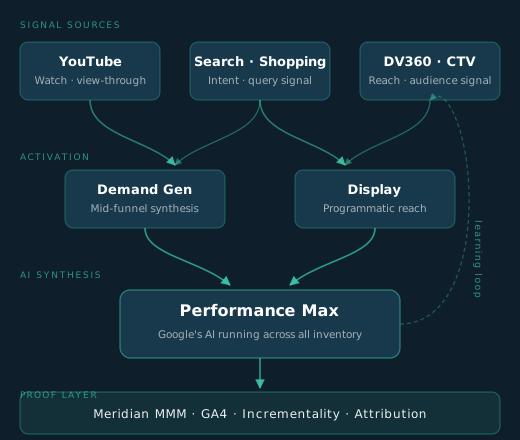
The Google advertising ecosystem is one connected system, not a portfolio of channels. YouTube signals feed Search intent. Demand Gen sits in the consideration layer. Performance Max synthesizes everything. Advanced Measurement Solutions prove the value of the whole. The advantage compounds when you treat them as a single loop — and disappears the moment you put them in silos.

Most organizations still treat Google's products as separate channels with separate budgets and separate teams. That's the silo problem — and it's costing them compounding performance they'll never see, because the AI inside PMax only gets smarter when the upstream signals do.

Uncommon Move is about seeing the whole thing at once — and engineering the signal environment so AI can do what AI is now good at.

Signal Flow — how the ecosystem actually works Dedicated page → Download SVG ↓
1. Signals flow upYouTube, Search, and DV360 feed structured intent into the consideration layer.
2. AI synthesizesDemand Gen and Performance Max read the upstream signal and decide where dollars go.
3. Measurement provesGA4 and the MMM layer turn the loop into something the CFO can defend.

How to read it: follow the arrows bottom-up. The thicker the line, the higher the signal density between two surfaces. The dashed lines are where most enterprise teams have a broken loop — usually between PMax and the measurement layer.

Google Ads Signal Flow Diagram — YouTube, Search, Demand Gen, Performance Max, Meridian MMM Signal flow diagram showing how YouTube and Search signals feed into Demand Gen and Performance Max, with Meridian MMM and GA4 as the underlying measurement layer. SIGNAL SOURCES YouTube Watch · view-through Search · Shopping Intent · query signal DV360 · CTV Reach · audience signal ACTIVATION Demand Gen Mid-funnel synthesis Display Programmatic reach AI SYNTHESIS Performance Max Google's AI running across all inventory LEARNING LOOP PROOF LAYER Meridian MMM · GA4 · Incrementality · Attribution
This is the Google Ads ecosystem diagram most planning decks gesture at but never actually draw. It maps the four tiers that every serious 2026 strategy has to engineer together — signal sources (YouTube, Search, DV360), activation (Demand Gen, Display), AI synthesis (Performance Max), and the proof layer (Meridian MMM, GA4, incrementality). The arrows are the signal density between surfaces, and the dashed feedback loop is where most enterprise teams are missing a connection — usually between PMax and measurement.
The system most teams only see one piece of. Print it. Tape it to a wall. Argue with it.
📐
A note on Advanced Measurement Solutions
The next generation of Advanced Measurement Solutions — modern Marketing Mix Modeling (Google's open-source Meridian), GA4, data clean rooms, and rigorous incrementality testing — represents a fundamental shift in how organizations can understand the true incrementality of their media investment. Advanced measurement is no longer optional for organizations serious about defending and scaling their Google investment. This is an area I go deep on — because it's the technical credibility that separates practitioners who really understand the ecosystem from those who don't.
Advanced Measurement SolutionsMarketing Mix ModelingGA4Incrementality TestingAttribution ModelingData Clean Rooms
Why do most enterprise marketing teams underperform their stack?

How the
advantage compounds.

Most enterprise marketing teams underperform their stack because they have a connection problem, not a capability problem. The Google ecosystem, the measurement layer, the AI capability, and the business strategy all exist inside the building. But nobody's drawing the lines between them — so the loop never closes and the advantage never compounds.

When you connect them, something changes. Measurement proves the ecosystem's value. That earns investment. Investment fed into better signals makes the AI smarter. Smarter AI compounds performance. Compounding performance drives profitability. Profitability gives leadership the confidence to redesign the org around AI rather than around yesterday's assumptions.

That's the loop. Most organizations are only inside one piece of it. The unlock isn't a better campaign — it's a lower Cost Per Decision across the whole stack.

Step 1
Business Strategy
Where does the organization need to go? What does profitable growth require?
Step 2
Ecosystem Execution
Google Ads, YouTube, Demand Gen, PMax — running as one connected system.
Step 3
Advanced Measurement
MMM, GA4, incrementality — proving what's working and why.
Step 4
Agentic AI
Autonomous systems executing, optimizing, and iterating across the whole stack.
Step 5
Cost Per Decision
Re-engineering the org around AI economics — collapsing the cost and latency of every marketing decision.
Step 6
Compounding Returns
Each loop gets smarter. Performance compounds. Confidence compounds. Profit compounds.
The outcome
An organization that gets structurally more profitable over time.
How does AI-driven marketing show up on the P&L?

A signal change in Google Ads doesn't stop at marketing.
It compounds through the whole business.

AI-driven marketing shows up on the P&L through a chain that most teams never draw end-to-end: better signals → lower CAC → expanding LTV/CAC → freed working capital → reinvestment velocity → valuation multiple. The interesting question isn't "did CAC drop?" — it's what the rest of the chain does with the dollars CAC freed up.

Signal architecture

Cleaner first-party signal feeds Google's AI. PMax learns faster. Wasted impressions collapse.

→ Lower wasted spend

CAC contracts

Same demand captured for fewer dollars. The cost to acquire a customer drops 10–30%.

→ Lower CAC

LTV/CAC ratio expands

Same customers, less acquisition cost. Unit economics improve without touching the product.

→ Healthier unit economics

Working capital frees up

The dollars that were paying for inefficient growth become real, redeployable capital.

→ Capital availability

Reinvestment velocity

Freed capital fuels the next acquisition cycle — at the new, better unit economics. The loop compounds.

→ Market share gains

Valuation multiple expands

Sustainable, capital-efficient growth is what public and private markets pay a premium for. The whole enterprise reprices.

→ Enterprise value
Also in the Lab Morning Drive — an agentic brief that turns Google Ads telemetry into a narrative your CMO can act on. See how it works →
What is Cost Per Decision and why does it matter?

Stop measuring Cost Per Lead.
Start measuring Cost Per Decision.

Cost Per Decision is the labor, latency, and capital required for an organization to reach and act on a single marketing decision. It's the metric agentic AI actually moves — and the one almost nobody is tracking yet. Move the sliders. Watch the number. This is the structural margin lever the CFO should be reading, not the marketing team.

20 people
5200
60
10500

Campaign edits, budget shifts, creative approvals, audience tweaks, bid changes — anything someone has to decide before it happens.

12 hours
4 hr80 hr

Time from "we should change this" to "the change is live." Includes meetings, analysis, approvals, execution.

Your numbers
Current Cost Per Decision
$1,440
Per marketing decision, fully loaded
↓ with agentic AI handling routine decisions
Agentic Cost Per Decision
$216
85% reduction · 5× faster cycle time
Weekly capacity unlocked $73,440
Annualized $3.8M
In language the rest of the C-suite uses
Equivalent net-new FTE capacity ≈ 6 people
Share of marketing org loaded cost ≈ 31% of payroll

Translation: this isn't a marketing optimization — it's a structural margin lever the CFO should be reading.

Estimate based on $120/hr blended marketing labor cost, agentic systems reducing routine decision cycle time by 70% and human-touch overhead by 50%. Order-of-magnitude only — directional, not boardroom. Real numbers come from a proper engagement.

What does an AI testing lab actually run?

The AI Marketing Lab.
Experiments, not essays.

Most marketing thought leadership stops at the take. The Lab is where I publish the experiment behind it — hypothesis, method, result, what changed. Every experiment is a small, reproducible test of how AI rewrites a piece of the marketing stack.

Numbers below are from sandboxed pilots and personal projects, anonymized where partner work is involved. Replication notes and prompt chains are linked from each writeup.

All experiments →
Experiment 01 Complete

Simulating 10,000 customer objections against a SaaS landing page

Hypothesis

An LLM, briefed on a real ICP, can generate a richer objection set than a human researcher can in a quarter — and surface the specific copy gap that's quietly killing conversion.

Method

Generated 10,000 simulated objections across 12 ICP variants. Clustered them. Mapped each cluster to a hero-section copy variant. Ran four variants against live traffic for 7 days.

Result
+34%

Lift in landing-page conversion vs. control. Winning variant addressed an objection cluster ("we already have a tool for this") that no one on the team had named.

What changed in my thinking

Customer research used to be a quarterly cost. It's now a continuous input the creative loop runs against every week.

7-day test · 4 variants Read the writeup →
Experiment 02 In flight

Compressing a Performance Max signal-tuning cycle from 6 weeks to 48 hours

Hypothesis

An agentic loop reading PMax placement reports, generating audience-signal hypotheses, and pushing tested variants back into the account can collapse the typical signal-tuning cycle by an order of magnitude.

Method

Built an agent that reads weekly PMax diagnostics, proposes 3–5 signal changes (audience signals, conversion value rules, asset group splits), and stages them for human approval. Measuring time-to-decision and CPA delta vs. a manual baseline.

Early result
~5×

Faster cycle time on the first three iterations. CPA impact still being measured against a clean control window — full writeup once the test reaches statistical confidence.

What's interesting so far

The bottleneck moved. It's not "can the agent decide" anymore — it's "can the org approve fast enough to keep up." That's a Cost Per Decision problem, not a tooling problem.

Running · week 4 of 8 Read the mid-run notes →
Experiment 03 Queued

Re-running last quarter's MMM with synthetic creative-quality features

Hypothesis

Standard MMMs treat creative as a black box. If we extract structured creative features with a vision model — hook archetype, pacing, claim density, brand-asset prominence — and feed them in as covariates, the model's residual variance drops materially.

Method

Take a 12-month YouTube + Search dataset, score every creative on ~20 features via a vision-language model, refit the MMM with the new features included, compare R² and channel-level effect sizes against the baseline model.

What I'm trying to prove

That "creative is unmeasurable" is a 2022 belief. The same MMM that proves channel value should be proving creative value too — and the CMO who runs that model first gets a real conversation with the CFO.

What I need

A partner with 12+ months of clean media + creative metadata. Reaching out — happy to share method and the eventual writeup in exchange for the dataset.

Looking for a partner See the method →
A working roadmap, published in public

What the market will need to know in Q3 2026
— and why I'm building it now.

By the time most teams know they need this, it'll be too late to be early. Each item below is a bet on what the next six months will demand. Subscribers get them first.

Updated: Q2 2026

  • The PMax agentic loop — proof, not promise

    Experiment · This month

    The stakes: Every PMax consultant on LinkedIn is selling "AI automation." Almost nobody is publishing a controlled comparison. Closing out Experiment 02 with a clean control window, the prompt chain, and the diagnostic-reading template — so the result is replicable, not just impressive. The first teams with a defensible automation playbook win the next budget cycle.

  • The AI Testing Lab playbook for CMOs

    Framework · Q2

    The stakes: Every CMO is being asked "what's our AI strategy" by a board that doesn't know what to ask. A 5-person internal testing lab is the answer — and almost no one has the playbook. Roles, cadence, first three experiments, metrics that actually move. The thing I'd hand a CMO on day one. This is the deliverable that turns "we're exploring AI" into "we ship one experiment a week."

  • Vision-features-into-MMM — breaking "creative is unmeasurable"

    Experiment · Q3

    The stakes: The CMO who first proves creative value inside the MMM gets a real seat at the CFO conversation. The CMO who doesn't is still defending budget with last-click data in 2027. Lining up a partner for Experiment 03. The question isn't "does it work?" — it's how much of "creative is unmeasurable" was a tooling limitation we stopped questioning.

  • The 5-Minute Status Quo Audit

    Site · Q2

    The stakes: The Framework is a 14-page commitment. A 5-minute audit is what a senior leader can run during a coffee — and discover the gap before their competitor does. A one-page checklist scored against the four pillars. The lighter on-ramp into the same diagnostic the enterprise engagements use.

Where do I start reading?

Marketing Mix Modeling, GA4, Performance Max & Agentic AI.
Fresh takes, no filler.

All posts →

The Metric That Was Never Measurable — Until Now: Cost Per Decision

Every marketing KPI in common use measures activity, not decisions. The gap is where margin and competitive advantage quietly leak out of the modern enterprise — and agentic AI is the first technology that makes the correction operable, not aspirational. The anchor argument behind every vertical piece on this site.

Marketing on the P&L: From CAC to Enterprise Value

A marketing decision doesn't stop at marketing. It compounds through CAC, LTV/CAC, working capital, reinvestment velocity, and the multiple the market pays for the enterprise — the chain most teams never draw end-to-end. The finance-facing half of the Cost Per Decision thesis, and where the real competitive advantage actually lives.

The Sealed Auction: Why Google's Search Surface Is Going Opaque in Q3 2026

For 22 years, Google Search has been the most transparent ad auction in the world. By Q3 2026 — AI Max, SQR opacity, and prose-input briefs — it goes sealed. One prediction layer, not three. The single decision every marketing team has to make before September: stop treating the platform's reporting as your evidence layer, and build one you own.

Last-Click Attribution Is Dead. Meridian MMM Is What Replaces It.

Google's open-source Marketing Mix Model isn't just a measurement tool. It's the confidence infrastructure that lets enterprise teams finally stop defending budgets with broken attribution.

What Agentic AI Actually Means for Marketing Teams in 2026

Beyond prompts and chatbots — AI that acts, decides, and executes across systems. What this means for how marketing gets done.

Who is behind Uncommon Move?

Deep in the ecosystem.
Thinking beyond it.

I'm Kyle Schwietz. Nearly two decades inside Google Ads — since 2008 — mostly answering one question for marketing leaders: not what the system did, but why.

I publish the frameworks here because the field is moving too fast to keep the playbook private — and because most of what passes for "AI marketing" right now is a productivity story, not a structural one. The structural story is what this site is for.

Full Google ecosystem operator Advanced Measurement Solutions practitioner Agentic systems builder Marketing-to-P&L thinker Publishing experiments, not just essays
Kyle Schwietz — Founder, Uncommon Move

"The status quo wasn't wrong. It was the best we could do without AI. The advantage now belongs to the teams that build the new frameworks first."

Read the full story →

Built from live experiments and 18 years inside Google's stack, not vendor playbooks. Open to scaling these frameworks inside a forward-thinking marketing team.

Frequently asked

Common questions on AI marketing strategy, Google Ads, Advanced Measurement Solutions, and agentic AI.

What is the AI Advantage in Marketing?

The AI advantage in marketing is the gap between what was possible with the old toolkit — manual segments, quarterly tests, generic personas — and what is now possible when prediction, simulation, and autonomous execution are part of the stack. It is a window of structural advantage available to teams that build the new frameworks first.

What does an AI-native marketing department look like?

An AI-native marketing department is one where the Google ecosystem, the measurement layer, the agentic systems, and the business strategy run as a single connected loop instead of six disconnected workflows — with real-time audience clusters, 48-hour testing cycles, signal-driven creative, advanced measurement, and agentic systems handling routine decisions.

How does the Google advertising ecosystem fit together?

The Google advertising ecosystem is one connected system, not a portfolio of channels. YouTube signals feed Search intent, Demand Gen sits in the consideration layer, Performance Max synthesizes everything, and Advanced Measurement Solutions prove the value of the whole. The advantage compounds when teams treat them as a single loop and disappears the moment they put them in silos.

What is Cost Per Decision?

Cost Per Decision is the labor, latency, and capital required for an organization to reach and act on a single marketing decision. It is the metric agentic AI actually moves — and the structural margin lever most marketing teams are not yet tracking.

Why does every marketing department in 2026 need an AI Testing Lab?

An AI Testing Lab is a small internal function that runs LLM-simulated experiments and 48-hour testing loops against real audiences and creative. It compresses the time-to-learning from months to days, which is the core competitive advantage available in 2026 for any marketing department that builds one first.

How does AI-driven marketing show up on the P&L?

AI-driven marketing shows up on the P&L through a chain that most teams never draw end-to-end: better signals lower CAC, expanding LTV/CAC, freeing working capital, raising reinvestment velocity, and ultimately expanding the valuation multiple. The chain is where the marketing decision and the valuation decision become the same decision.

What does an AI testing lab actually run?

An AI testing lab runs short, reproducible experiments that test how AI rewrites a piece of the marketing stack — for example, simulating thousands of customer objections with an LLM, compressing Performance Max signal-tuning cycles with an agentic loop, or extracting structured creative features with a vision model and feeding them into MMM. Each experiment is published with hypothesis, method, result, and what changed in thinking.

A small list. Direct access. No queue between us.

Reply to any issue. Your answer comes from me — not a team.

The list is small on purpose. I keep it that way so the inbox stays a working channel — senior marketing and finance leaders asking the questions they can't ask in a vendor meeting, and getting an answer from someone who's actually built the thing. Twice a month, no recycled takes, no "10 AI tools" lists.

  • Every reply lands in my inbox. Not a CRM, not a queue. Most subscribers and I are one or two emails into a real conversation.
  • The Framework, free on signup — 14-page Signal Architecture PDF, the same one used inside enterprise stacks.
  • Lab experiments a week before they're published — subscribers see the result before it hits the site.
  • The CFO translation layer — every issue ends with how the week's idea reads on the P&L, not just on a dashboard.

Free. Twice a month. Unsubscribe any time. The Framework downloads immediately on signup.

Prefer the web version? Read the Framework online →