The Performance Max Hub

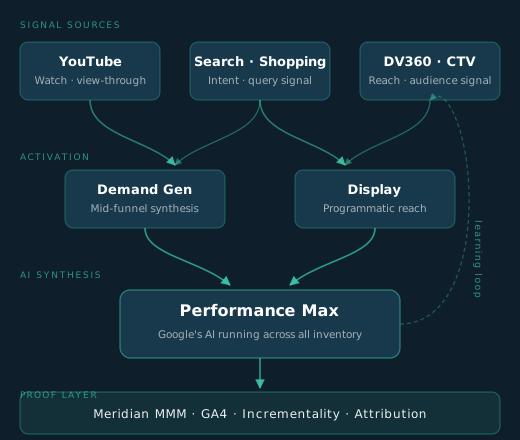
Performance Max isn't a campaign type.
It's a signal feedback loop.

Most teams manage PMax. The accounts that compound engineer the signal environment around it. This hub is the complete operating reference — the architecture essay, the 10-point signal audit, two working Lab experiments, and a downloadable checklist you can take into a Monday morning planning meeting.

Jump to the 10-point audit ↓ Download the checklist →
On this page
The argument in one paragraph

What Performance Max actually is.

Smart Bidding inside Performance Max is a machine-learning system. Like every machine-learning system, the quality of its output is bounded by the quality of its input. The input isn't your bid strategy or your daily budget — those are constraints, not signals. The input is the corpus of signals telling the model what a valuable conversion looks like, who valuable customers tend to be, what creative variants resonate with which audience clusters, and which conversion events are worth pursuing at the margin.

When teams complain that "PMax is a black box," what they usually mean is that they can't see placement-level reporting. That's a real transparency limitation. It is not, however, an optimization problem. The optimization is happening. It just may be optimizing against signals that look nothing like the goal the team thinks they set. The whole argument — including the cleanest failure mode (firing valueless "lead" conversions and watching Google find the cheapest path to garbage form fills) — is laid out in the anchor essay.

Read the full essay: Performance Max Isn't a Campaign Type. It's a Signal Feedback Loop. →

The architecture

The five signal layers that decide whether PMax compounds.

Every PMax account compounding in 2026 is engineering five signal layers underneath the campaign. Every account stuck is missing at least three.

Signal Layer 01
First-party data & conversion infrastructure
Customer Match audiences, Enhanced Conversions, server-side tagging, and a clean event taxonomy that survives consent mode and iOS. This is the foundation. If conversion tracking is leaky, every downstream signal is built on a corrupted base.
Signal Layer 02
Conversion value architecture
If every conversion is worth "1," the model optimizes against volume. Value-based bidding requires populated value fields, value rules for asymmetric conversion types, and ideally offline conversion uploads that backfill actual revenue or LTV. Smart Bidding is a value optimizer; if you don't give it value, it can't optimize for value.
Signal Layer 03
Audience signals & exclusions
PMax's audience signals aren't targeting in the old sense — they're a steering input. Customer Match seed lists, lookalikes, in-market audiences, and first-party data tell the model where to explore from. Most accounts hand the algorithm a blank map and then wonder why it wandered into the wrong neighborhood.
Signal Layer 04
Creative as signal
PMax doesn't run a single ad. It runs a combinatorial system of headlines, descriptions, images, video, and feed assets, recombined across surfaces. Asset diversity, format completeness (especially video coverage), and creative refresh cadence are direct optimization inputs — not aesthetic decisions made on a quarterly calendar.
Signal Layer 05
The proof layer
PMax allocates across surfaces in ways that don't map cleanly onto channel reporting. Without an independent measurement layer — incrementality testing, geo-holdouts, ideally Meridian MMM — you have no way to know whether PMax is genuinely incremental or harvesting demand. The proof layer is what lets you defend PMax investment when finance asks.
The diagnostic

The 10-point Performance Max signal audit.

Run this before you touch a bid strategy. The order matters — earlier items gate later ones. Score each yes / partial / no. Anything below 8/10 is a signal-architecture problem masquerading as a PMax problem; fix the signal layer first and campaign performance follows.

The 10-point Performance Max signal audit

Designed to be run in a single 90-minute working session with the channel lead, an analytics partner, and someone who owns the CRM.

From The Lab

Working experiments — not theory.

Two of the live experiments in the Uncommon Move Lab are testing the architecture above against real PMax accounts. Hypothesis, method, result, and what changed in the thinking, published as the work happens.

Experiment 001
Can one Performance Max signal shift audience mix in 14 days?
A controlled test of whether a single value-based conversion signal can shift PMax audience mix toward higher-AOV cohorts in 14 days — without changing creative, budget, or targeting. Isolates Signal Layer 02 against everything else.
Hypothesis · Method · Result · 8 min read
Experiment 002
Can an agentic loop compress PMax signal-tuning from 6 weeks to 48 hours?
Hypothesis · Method · Early result · 10 min read
Take it with you

The downloadable Performance Max signal audit.

A printable one-page version of the 10-point audit above, designed to be marked up in a meeting and walked out the door. Use it before the next quarterly review, the next vendor pitch, or the next "why isn't PMax working?" conversation.

The 10-Point PMax Signal Audit

One page, ten boxes, no marketing fluff. Anything scoring below 8/10 is a signal-architecture problem, not a campaign problem.

Open the checklist → Get the full 14-page Framework →
Frequently asked

Five questions about Performance Max, answered straight.

Is Performance Max a campaign type or a campaign system?
Performance Max is best understood as a signal feedback loop running on top of Google's ML, not a conventional campaign type. The work isn't managing the campaign — it's engineering the signal environment around it: conversion infrastructure, value architecture, audience signals, creative as combinatorial input, and an independent proof layer.
Why does Performance Max underperform for some accounts?
Almost always a signal-architecture problem rather than a campaign problem. The most common failure: firing valueless conversions (every lead = 1) so the bidder optimizes for volume of cheap form fills instead of quality revenue events. Other common failures: no Customer Match seed lists, no offline conversion uploads, missing video assets, and no incrementality measurement to defend the spend.
What are the five signal layers that decide whether PMax compounds?
First-party data and conversion infrastructure; conversion value architecture; audience signals and exclusions; creative as signal (asset diversity, format completeness, refresh cadence); and the proof layer (incrementality testing or MMM). Every PMax account compounding in 2026 is engineering all five. Every account stuck is missing at least three.
Can agentic AI run Performance Max signal-tuning automatically?
Yes — and that's the subject of Lab Experiment #002. An agentic loop that reads weekly PMax diagnostics, proposes 3–5 specific signal changes, and stages them for human approval can compress a 6-week signal-tuning cycle to roughly 48 hours. The agent is patient with attribution windows in a way humans cannot afford to be.
How do you measure Performance Max incrementality?
Two methods, used together. Geo-holdout incrementality tests on PMax spend isolate whether the lift is real or harvested demand that would have converted through Search anyway. Marketing Mix Modeling — ideally Meridian MMM or equivalent — provides the cross-channel attribution that placement-level reporting cannot. Without one of these, you cannot defend PMax investment when finance asks the hard questions.

Stay Sharp.

Get the next PMax-adjacent experiment, framework, and teardown the moment it's published.