
Every dollar you spend in Google Ads buys two things. The first is media: the clicks came in, the conversions got counted, the ROAS landed somewhere between celebration and explanation. The second is a continuous stream of market intelligence: what your customers are literally typing when they need you, how your competitors are behaving in the auction, which messages the market rewards and which it shrugs at, where demand is projected to move before it moves. Google generates this exhaust automatically, deposits it inside your account, and waits. Almost nobody comes to pick it up.
Call it ad exhaust: the intelligence byproduct of a running ad account. Teams will fight for weeks over a 0.2 change in ROAS, the what, while the reports explaining the why sit three tabs away, unread. The performance data gets a dashboard, a weekly meeting, and an executive summary. The intelligence data gets nothing. Not because it isn't valuable, but because nobody's job is to read it.
That gap is now exploitable. The fix isn't headcount. It's an agent, though not the kind currently being sold to you.
The scoreboard and the game tape
Ask a marketing team what their Google Ads account tells them and they'll describe a scoreboard: spend, revenue, CPA, conversion volume. Scoreboard metrics are necessary. They're also the least differentiated information in the account, because every competitor is staring at the same categories of numbers, optimized by roughly the same Google AI, converging toward roughly the same efficient frontier.
The game tape is different. The game tape is what the account records about behavior: yours, your competitors', and the market's.
Search terms are voice-of-customer research running at production scale, or at least the audible portion of it. Since 2020, Google only shows you terms that clear a privacy threshold; depending on the account, the hidden share can run from a fifth to half of activity. But the visible stream is still the largest ongoing record of what buyers actually type, in their own words, this week. When "non-toxic" starts climbing in your query mix, that's not a keyword insight. That's the market renegotiating your category's vocabulary in real time. It's information your brand team would pay six figures to approximate with focus groups, sitting in a report the paid search specialist skims for negative keywords.
Auction insights are the closest thing you have to a competitor behavior feed. Overlap rate, outranking share, top-of-page rate: tracked over time and by device, these show you when a competitor lunges into your territory, retreats from it, or shifts weight between Search and Shopping. It's a noisy feed. Your own budget and bidding changes move these numbers too, and a competitor who "disappears" may have just dropped below the report's visibility threshold. Read carelessly, it misleads. Read as a time series, with your own change history controlled for, it's strategy surveillance you're conducting from inside the auction. Most teams glance at it quarterly, as a static table, stripped of the time dimension that makes it intelligence.
Asset performance ratings are directional message testing you didn't have to commission. When Google grades your creative assets against each other, it's telling you, imperfectly and without a controlled exposure, which claims and value propositions the market responds to. Not a clean test. But it's free, continuous positioning research, and it dies inside the ads team as "swap the Low performers."
Demand forecasts are a forward-looking market model. The Insights page has projected category demand up to 180 days out since 2021. A forecast is not a reporting artifact. It's an inventory, staffing, and merchandising input, and it almost never travels to the people who own inventory, staffing, or merchandising.
And the exhaust is getting richer, not thinner: Performance Max, long the sealed box of the ecosystem, now exposes its full search terms report, and since v23 of the Ads API, channel-level performance down to the asset group. Some of that surfaces only through the API, not in the interface at all. There is now exhaust that no one clicking around the UI will ever see.
Which raises the obvious question: if this is all just sitting there, why does nobody use it?
Why the exhaust goes unread
Because the cost per decision is brutal.
Turning exhaust into a business decision means pulling half a dozen reports across a time window, joining them against each other and against context Google doesn't have (your margins, your inventory, your competitor's press releases), then writing a narrative that a human outside paid search can act on, then getting it to the right human. Done properly, that's hours of senior-level synthesis per insight. Done weekly, it's a full-time job that no org chart contains: too strategic for the media team's mandate, too in-the-weeds for the strategy team's attention.
Don't assume your agency fills the gap, either. Agency incentives point at media efficiency, the scoreboard, and agency synthesis arrives quarterly, in a QBR deck, looking backward. Reading your exhaust for merchandising and positioning signal isn't what the retainer buys, and it isn't what the account team is staffed for.
So the work simply doesn't happen. The insight wasn't too expensive to generate. Google generated it for free. It was too expensive to read.
"The insight wasn't too expensive to generate. Google generated it for free. It was too expensive to read."
That is precisely the kind of cost that agentic AI collapses: not by optimizing anything, but by making continuous synthesis cheap enough to exist.
Not another optimization agent
"AI agent for Google Ads" already means something, and it's not this. The agents flooding the market, including Google's own, are optimization agents. They live inside the account and push performance: bids, budgets, creative rotation, query exclusions. They compress the what. Useful, and table stakes, because your competitors run the same ones against the same objective functions.
The agent I'm describing is an intelligence agent. It points the opposite direction. It never touches a bid. Its job is to read everything the account knows, notice what changed, form a hypothesis about what it means for the business, and put that hypothesis in front of the right person. Most of those people will never log into Google Ads in their lives. Concretely, it runs a loop:
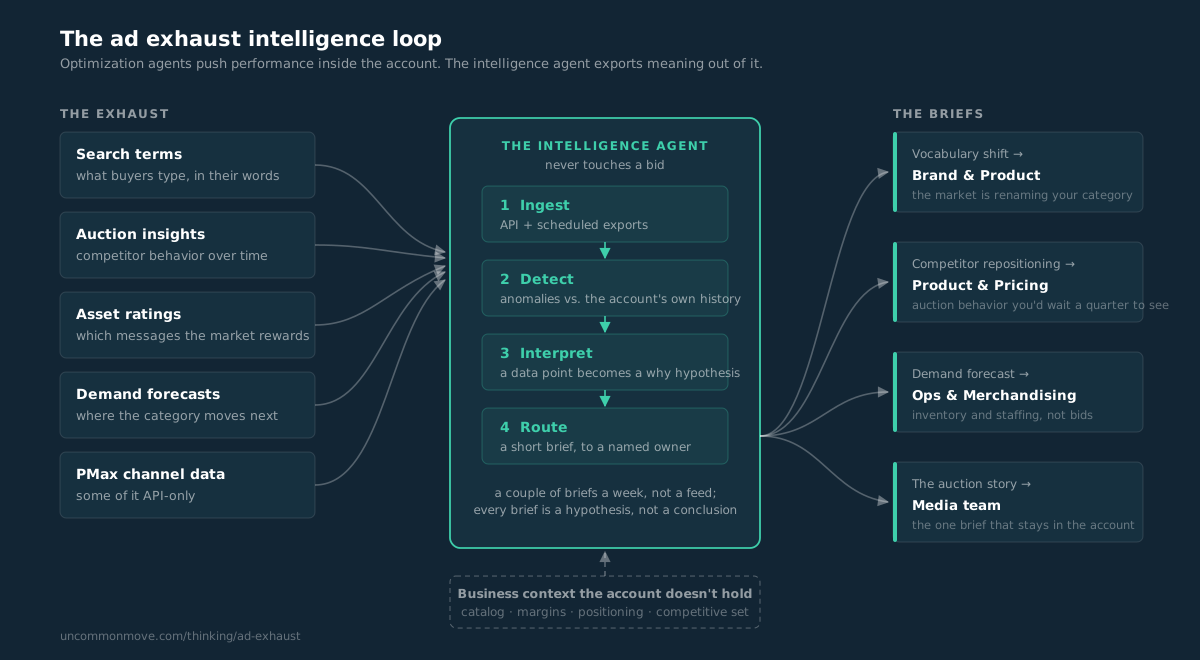
And yes, the failure mode is obvious: an agent that narrates noise, sending confident fiction to your head of product. Two design choices contain it. The hard problem isn't connecting signals. It's deciding which three of the week's two hundred anomalies deserve connecting. So the detect step is ruthless about materiality thresholds, and the loop ships a couple of briefs a week, not a feed. And every brief is framed as a hypothesis with a named owner, not a conclusion. The human it routes to is the check. A wrong hypothesis that gets examined and killed in ten minutes still beats a right signal that expires unread.
What that looks like in practice
A composite, assembled from patterns real accounts produce. Messier in life than on paper, which is the point:
A mid-size DTC cookware brand runs the loop. Over a few weeks, three signals surface in three different reports. Queries around "non-toxic" and "PFAS-free" have roughly tripled in the visible query mix while converting well above account average; the base is small, which is exactly why they're still being treated as long-tail trivia. Auction insights show the largest competitor's overlap rate sliding on core cookware terms while their Shopping overlap climbs, a divergence the brand's own change history doesn't explain; a check of the live Shopping results shows that competitor's ceramic-coated line newly dominant. And the demand forecast projects a category interest spike in what the media plan treats as shoulder season.
A sharp paid search manager might catch any one of these; the query trend was probably already flagged in someone's optimization notes. What no one had done was connect them, because the connection isn't a media insight. The agent's brief:
Routed to: Head of Product, Brand Lead · A hypothesis, not a conclusion · 40-second read
The market is renegotiating the category's vocabulary around material safety. Your biggest competitor appears to be repositioning ahead of a demand wave. You currently have no landing page, product copy, or creative asset containing the language your highest-intent customers now use.
That brief goes to the head of product and the brand lead, not the media team. The decision it drives is merchandising and positioning. The media plan barely changes. And the response happens in weeks, not eighteen months later in a category report, after the competitor owns the language.
Nothing in that story required proprietary data. It required reading: continuously, across silos, with business context. That's the entire trick.
The exhaust reads differently by vertical
The cookware story is retail, but the loop isn't. What changes by vertical is which stream carries the signal, and how far from the media team the brief needs to travel.
In e-commerce and retail, you've just seen it: the exhaust is richest there (Shopping overlap, product-level query language, channel breakdowns), and the brief's natural owner is merchandising, not media.
In finance, you're bidding on some of the most expensive clicks in the auction, and every macro event reprices them. Auction insights around a rate move become a read on your competitors' appetite: which challengers lean into deposit terms and which pull back is a signal about their CAC tolerance that you otherwise wait for an earnings call to see. Meanwhile the query mix shifting between "high-yield savings," "CD rates," and "money market" is a live map of where deposits are thinking about moving, ahead of the flows showing up in industry data. That brief belongs with product and pricing.
In healthcare, the exhaust matters for the opposite reason: scarcity. Google restricts personalization and audience data for health categories, so the account holds far less than in other verticals, which makes the one stream that survives, query language, disproportionately valuable. Condition and treatment vocabulary shows service-line demand forming before referral patterns move; ask anyone who watched GLP-1 queries climb before their strategy team had a position on it. And because the exhaust is aggregate market signal rather than patient-level data (reading a query report is not the same compliance conversation as running tracking pixels), it's one of the few ad-adjacent intelligence streams that can survive review. The brief goes to service-line planning.
Same loop every time. The constant across verticals: the account lives with the media team, but the brief's rightful owner almost never does.
What the minimum version costs
This doesn't start as a platform build. Week one is one analyst, API access you already qualify for, and a working session with a frontier model. The scaled version (scheduled ingestion, anomaly thresholds, routed briefs) is a modest internal build or a few thousand a month with a vendor, not a data-team odyssey.
Three moves. If two of the three briefs make someone outside the media team say "wait, really?", you have your business case.
- 01. Export three months of exhaust. Search terms, auction insights over time, and asset performance ratings. Nothing fancy: the standard reports, pulled with the time dimension intact.
- 02. Ask for three anomalies with owners. Hand the exports and your business context to a frontier model and ask for the three most decision-relevant anomalies, each with a hypothesis and the person who should own it.
- 03. Put the function outside the media team. By this essay's own logic, the loop reports into strategy or insights. The media team is a recipient of the briefs. If it lives inside the team whose mandate is the scoreboard, it gets quietly re-pointed at the scoreboard within a quarter.
The part you actually own
Optimization converges; what you do with your exhaust doesn't, because the exhaust is unique to you. Your query mix, your auction neighbors, your creative results, your demand curve. Two competitors running identical optimization stacks still generate entirely different intelligence streams. Only one of them may be reading theirs.
There's one more reason to start now, and it's on a clock. As of June 2026, Google deletes granular ads reporting data (anything finer than monthly) once it's older than 37 months. The fine-grained time series, the baseline every anomaly gets measured against, is no longer something you can go back for later. The performance side of your account is a rented advantage; you share it with everyone bidding against you. The intelligence side is the part you actually own, and Google just started the countdown on how much of it you get to keep.
The practical version: pick one report you've never exported (auction insights over time is my choice) and ask what it would tell a competitor about you. Then build the loop before they do.